Pole defect detection

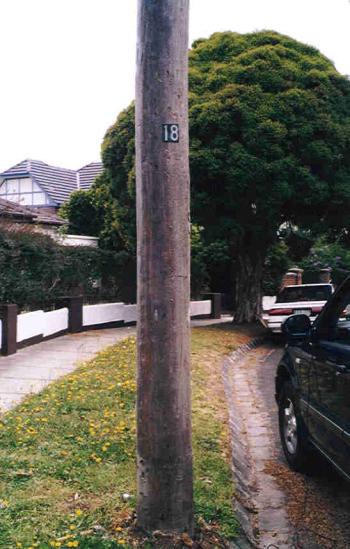
Traditional inspection methods would have not detected this defect. We are now past the development phase of our work and are now seeing the power of the MOD-SHOCK™ test in action.  The pole shown is typical of inner urban Melbourne, hardwood small diameter (d < 300 mm, ~12 inches).   It contains both transmission and distribution cabling as well as the dreaded TV cable feed. There is also a street lamp and five feeds off it. The upper part of the pole would be considered as complex.


The pole is located on a corner so there will be unequal forces acting on it.

Externally there are no signs of defects. Tapping the pole at head height about 2 metres above ground did not indicate any defect. The sounding appeared normal.

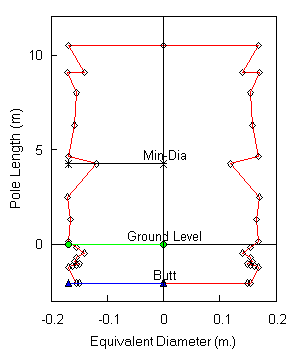
The model shows a loss of section below ground, which would have been found by normal exploratory drilling.  This loss probably reflects the loss of section caused to the pole due to the inspection exploratory drill holes.

A minimum diameter has been found at about 4 m above ground level.  The two cross arms have been detected though the cut in above the lower cross arm probably indicates a defect


The measured bending moment capacity was down from 160 kN.m to 96 kN.m, a drop in tip capacity from 20 kN down to 12 kN. Still serviceable but with reduced factor of safety from 4 to 2.5 approximately.


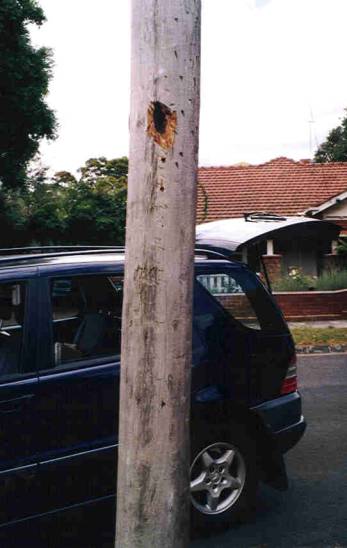
The defect was in fact a termite nest, and localised. The wall thickness on the exposed side is about 20mm or 3/4 inch with 50mm thickness on the other side.


The significance of the defect is that traditional opinion is that poles fail around ground line, but increasingly the failures occur around the 1/3 position up the pole from ground. It would be assumed to be maximum bending moment.


It is all right pronouncing that our test is the best available, but some justification has to be presented.  Out of a recent 500 pole distribution line tested our accuracy was over 95% with the 5% reporting defects, which couldn't be found and splices.


There is an education process yet to be embarked upon. Structural connections are managed induced defects in structures to facilitate construction.


We hope this small example goes someway to establish our non destructive test in pole inspection.

New comparisons can be found here at

technical papers


JH

Back