 |
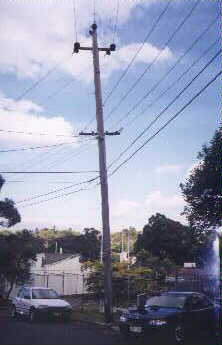
One of the major problems testing instiu poles is the wiring and usage.
The distribution wires are easy to see in the modelling but the lower wires,
cable TV or fibre are usually hung from a tensioned wire. But to
install the necessary infrastructure for the advent of the information
age then this is the possible best method. The pole looks overloaded and
by all standard expectations it is.
The test on the pole showed it still had a factor of safety (FS) of 2.7 in its present condition. Timber poles usually get retired at a FS. of 2, the usual starting point for most new structures!. This pole is about twenty years old. |
|
The lower wires shown in the adjacent photo are the cable TV wives. The twist or bend in the pole is natural. So why timber distribution pole? Well the life of a timber pole is well in excess of 50 years and after this they are usually reused in distribution when decommissioned from transmission service. Shortened and reused. Concrete poles have a life of about 20 years and cost two to three times more than timber. Timber poles are of course a renewable resource. Concrete poles are suspect to dramatic failure, with out warning! |
 |
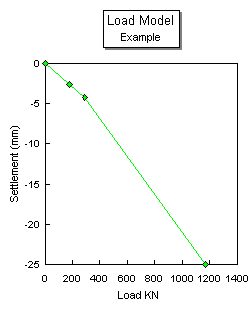
Testing poles is an exercise in lateral thinking, forget all the hand waving arguments about dispersive waves. We hit the pole on the side which generates longitudinal travelling waves in the pole. therefore the result is its vertical capacity not bending capacity. The horizontal capacity is required, logically true. We measure the Z modulus of the pole and the extreme fibre stress calculated from the measured vertical parameters. Knowing these, the pole capacity is known. Luckily the calculations to provide this can be fitted in a spread sheet, so along with displaying the model and pole stiffness we calculate the Z-modulus.
 |
 |
The results above are from the top left picture, the enlarged portions at approximately 5.0 metres above ground level correspond to stress points on the pole. The enlargements at the top correspond to the cross arms on the pole, whilst the reductions correspond to the deterioration of the pole timber.
These poles had a measured Z-moduli of 5.571E+06 mm3 and bending moment capacity of 4.174E+02 kn.m. at the minimum section.
We manufacture MOD-SHOCK tm testing equipment for transmission line inspection companies. The equipment includes data base capabilities and touch screen operation.