
Rock Bolts
Rock Bolts
|
Integrity has now added a new service to its present comprehensive suit of tests and consultancy services. As with any buried structure there is always the question what is there? There is also the question of what capacity or what is the rating of the bolt. A rock bolt basically holds surface rock formations to the parent rock massive. It may retain the surface rock blocks in tension, typically for tunnels. It may retain the rock face in shear, usually for cliff faces, rock cuttings and over hangs. Initially, we considered that 25 mm or even a 50 mm diameter rock bolt would be too slender to test. Our ModShock test is used on concrete and timber materials. Steel piles, piers are also tested. Given a modular ratio of steel to concrete / rock of about 20:1. A 25 mm steel rock bolt is equivalent to testing a 500 diameter concrete pile. Caution prevails as the analysis is a two dimensional problem and not just a simple scaling up process. More testing applications can be found at Integrity. Well we test the rock bolt head |
|||||
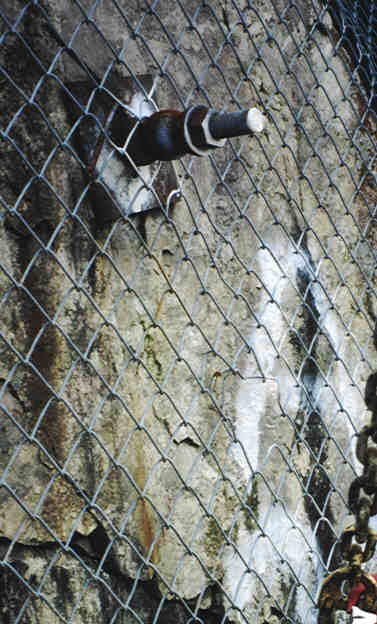 |
This is a 25 mm anchor probably 5m (18 ft.)
deep.
The bolt was probably hammered into a pre-drilled hole in to the rock. If it was an ungrouted anchor there would be a wedge leader such that the end of the anchor will be expand on fixing. This type of bolt is a mechanical anchor. In the photo left the rock bolt is acting in shear. There will be a tension component as this bolt is part of a large retaining system. In the diagram a few of the problems occurring with rock bolts is shown. Basically we measure the capacity of the bolt, how much load it can
take. We measure the cross section of the bolt whether the bolt has corroded
or whether the anchorage is lost.
|
||||
Measurement of bolt depth is one of the winning factors in the test
as steel is a uniform material with respect to propagation speed. Over
coring is another method, but for the cost of a core, probably up to 50
bolts could be measured and tested by our ModShock Method..
|
|||||
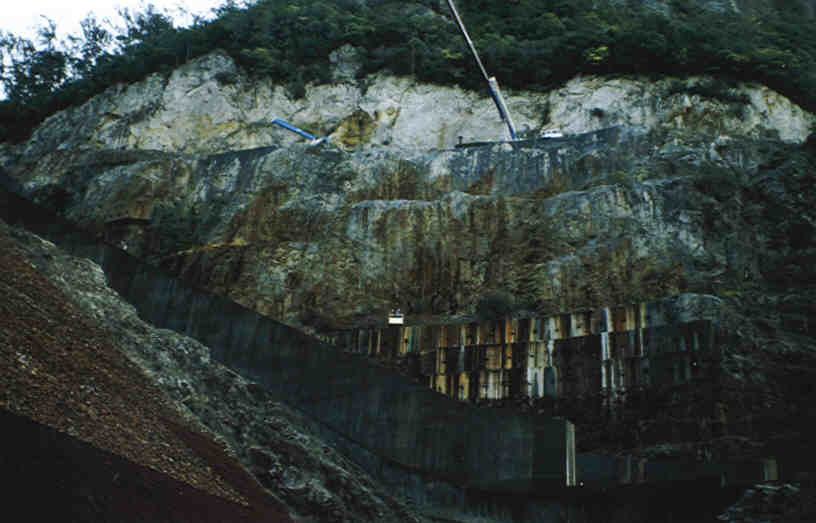
| We are in the bucket! 300 m down from
the spillway, the bucket is the white speck!
On this project we tested on average 50 bolts per day, analysis took a bit longer. Initial analysis at the time of testing gave a yes/no rating on the spot, so the geotech guys could look and expand the search area. Generally you would test all the bolts and map out the data for an overall risk assessment. |
|||||
 |
|||||
| For further information please contact
Contact us below
|
|||||

