We have turned our bridge testing on end and tested Towers. Towers are easy to test as they are bigger, it involves climbing however and no fear of heights!! In an age where dual usage of power transmission towers is common place there is a need to evaluate the tower capacity, what it was prior to loading and sway or movement limits especially for the higher bandwidth Microwave point to point transmissions.
There is is a common failure mode we have seen in the free standing towers we have tested which may require consideration for the next generation loading of these structures.
 |
This is a typical loaded free standing telecommunications tower. The
intermediate platforms act as stiffeners making the tower act as a single
unit. The inter leg variations are small unless the tower is about
to go into failure, but then the effect is sufficiently large enough to
be seen as a single unit.
The wind loading on this tower is large and lop sided. The large movement caused data loss or drop out in the worst case on two of the larger dishes. The transmission path length was long. |
|
We are looking at the mid portion of the tower. In summary of the paper we did on the testing we found that the tower rotated about the lower third about 10 m from the support. |
 |
Unfortunately we can't show the base of the tower due to confidentiality reasons. Then not allot happened there!.
|
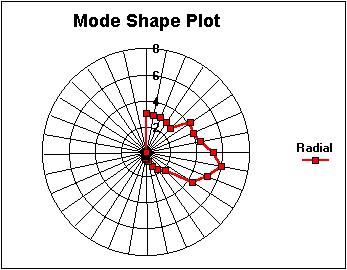
The radial plot of the tower mode shape shows the twist and coupled with the deflection at the lower third points to the failure plane of the tower. This failure plane migrates with various tower loadings. |
 |
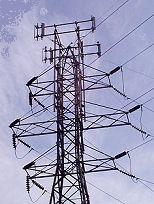 |
This is a dual usage tower for cell phone use we have tested similar. and with 3.2 Ghz dishes on them. |
We checked the results against a finite element programme and were surprised that out 16 node measured model got to within 90% of a 2,000 node FE programme. Actually the original aim of our test was to calibrate the FE model due to reasons we stated earlier. We just took it one step further why spend time and effort on the FE when you can measure the condition accurately in the field.
When we tried what if on our model we got within 20% of the FE
and erred on the lower side. In the final analysis the proposed up grade
was the same from both approaches. Power line towers apart from safety
aspects of access actually are better behaved than free standing.
Tethered towers are better still.