
We Undertake large number of vibration studies, so as a guide we have lifted the disscussion part of an old report ands present it here. We hope the information will be of use and if you require further information please contact either David or us
In order to understand the concept of the vibration measurements, some basic vibration physics is presented.
In any natural simple vibration (simple
harmonic motion), the following applies. It is noted that vibrations are
complex, however, each oscillation can be broken down into simple harmonic
motion.
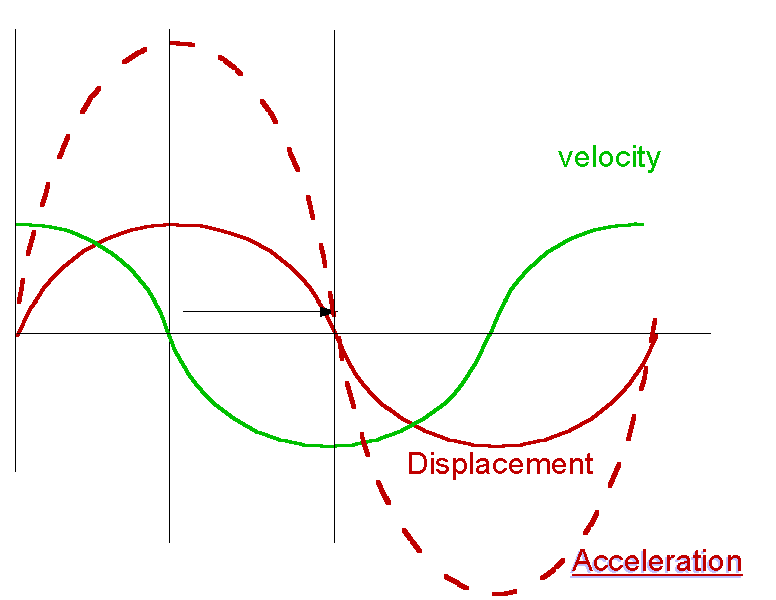
A sinusoidal displacement,
Displacement = a* sin (wt) holds the following
relationships.
Velocity = aw * cosine (wt) and,
Acceleration = -aw2 * sin (wt)
therefore,
Velocity = Displacement * w and,
Acceleration = - Displacement * w2
Fig-1
Where,
a = amplitude of displacement
t = time of the period of oscillation
Vibrations of buildings
There are two elements to consider when vibrations of a building are of concern; the source causing the forces which induce vibration, and the response of the buildings, or elements of the building, to those forces.
Vibration Sources
Sources, which cause buildings to vibrate, fall into two main categories; those that are repetitive (and very often caused by some man-made agency), and those that are random (and often caused by natural sources). Sources of man-made vibration are machinery, compressors, pile drivers, road traffic and aircraft; natural sources include the wind, earthquakes and wave action.
Wind is, by far, the most common source of naturally occurring vibration energy. It is not normally necessary in a design to consider wind-excited vibration of entire structures unless the structure is greater than four storeys in height. Wind excitation of elements of smaller structures (such as roofs) may well need special investigation.
The occurrence of repetitive loading, such as that caused by machinery, is rarely a problem for the integrity of a structure, unless the frequency coincides with a natural frequency of some element of the building. The effect on occupants, however, may be unacceptable well before any structural damage occurs.
(b) the damping of the resonance's of the buildings or elements;
(c) the diffuses of the building or elements;
(d) the magnitude of the forces acting on the building;
(e) the interaction of the building or elements with the vibration source.
The natural frequency of a building or an element in a building is, to a large extent, governed by its size and, to a lesser extent, by its fixity.
The natural frequency of a tall building
can be approximated by:

This simple formula has been shown to give results, which are as accurate as sophisticated and complex calculation procedures.
Damping values are more difficult to evaluate; generally in the absence of measurement, specialist advice should be sought.
Should the structure or nature of use be sensitive the specialist advice on stiffness, the magnitude of forces and the interception of buildings with the medium transmitting the forces should be sought. Some information can be found in reference literature.
The natural frequencies of elements of buildings, such as floors are largely governed by their physical dimensions.
Dynamic forces induced by people (when dancing for instance) may become unacceptably large if those people regularly jump up and down.
Cases where vibration has caused damage to buildings and its contents have been extremely rare and the generalisation can be made that vibration must become unpleasant or painful to the occupier long before there is any possibility of damage to the building itself.
Nevertheless, complaints are often perceived that minor damage, such as the cracking of plaster ceilings, brickwork and window glass, as well as the loosening of roofing tiles, have been caused by some particular source of vibration. Such complaints are common which may be due to the extreme sensitivity of the human body. When a new source of heavy vibration arises and is such as to disturb the occupier of a building, he may become concerned about the structural effects of such vibration. He may then assume that cracks, which have escaped notice for some time, have been caused by vibration. There are many causes of cracking in buildings and crack should not be attributed to the effects of vibration until other causes have been eliminated.
Work in USA in connection with blasting vibration included tests on floors and ceilings where deliberate attempts were made to cause damage by excessive blasting or by mechanical agitation, even under sustained resonant conditions. Sustained amplitudes of vibration of the order 2500 microns (2.5mm) were required to produce severe cracking of plaster and these are far in excess of the amplitudes produced by traffic, factory machinery, compressors, or other common sources of vibration.
Door slamming or walking about heavily is likely to produce greater vibration and shock than most external sources of vibration.
The actual perception of motion may not, in itself, be annoying. An individual's perception of what is "normal" or "abnormal" may depend on previous experience and expectations. For example, someone who lives, as well as works, in a multi-storey building may be less affected by building motion than someone who only works in such a building.
Recent British Research Establishment (BRE) tests, under controlled conditions in three tall buildings, showed that even when levels of vibration caused feelings of nausea in a number of subjects, the safety of the building was not prejudiced.
Under certain conditions the human body can detect amplitudes as small as one micron; amplitudes of the order of 0.50 micron can be detected with the fingertips (all displacements are peak amplitude). The basic data concerning "whole-body" sensitivity to vibration are provided by the Reiher-Mesiter scale. Although this was developed over sixty years ago, its validity is still accepted for steady-state vibrations, but for transient vibrations, e.g. floor vibration produced by people walking, there is evidence that amplitudes much greater than those given by the scale are necessary to produce sensation at a given frequency.
In the Reiher-Mesiter investigation it was noted that vertical vibration was most readily detected when people were standing, and horizontal vibration was more noticeable when laying down. The sensation produced depends on frequency and amplitude. An amplitude of 100 micron constitutes an annoying vibration if the frequency exceeds 5 Hz and a painful vibration if the frequency exceeds 20 Hz. An amplitude of 10 micron is just perceptible at 5 Hz, but would be annoying at 50 Hz.
Expressed in terms of peak velocity, the threshold of perception corresponds to a velocity of 0.3 mm/sec and a vibration is annoying if the velocity exceeds 2.5 mm/sec. This is half of our expected limit for the switchyard.
The problem concerned with human perception of random motion is covered in the DIN 4150 Standard (Table 1). In the standard, values for the degree of perception (K) are derived from :
It is likely that the majority of problems
concerned with vibration will be in the area of human tolerance to its
effects. Major sources of vibration energy are road and rail traffic and
the wind. Human tolerance is dictated not only by scientific but also psychological
factors, and as such a rigid definition of what constitutes a nuisance
may not be possible.
Relationship between K values and human perception of motions
| K Value | Degrees of perception |
| < 0.1 | not felt |
| 0.1 | threshold of perception |
| 0.25 | barely noticeable |
| 0.63 | noticeable |
| 1.6 | easily noticeable |
| 4.0 | strongly detectable |
| 10.0 | very strong detectable |
Table 2 - Suggested levels of vibrations acceptable for different buildings
Table 3 - Guide values for Peak Particle Velocity (PPV) during transient shaking
Table 4 - Swiss standard for vibration in buildingsTable5
Table 5 - Some typical vibration limits enforced in Sweden when the foundation is hard rock. Valid for short duration construction blasting (Person ET al, 1980)
Suggested levels of vibrations acceptable
for different buildings
acceptable intensities (K) (see Table
1)
| Building type | Time | Continuous
vibrations |
Repeated
vibrations |
Occasional
vibrations |
| Nursing homes | Day
Night |
0.1
0.1 |
0.1
0.1 |
2.5
0.1 |
| Residential | Day
Night |
0.1 | 0.2 (0.1)
0.1 |
4
0.1 |
| City residential
and business |
Day
Night |
0.3(0.15)
0.1 |
0.63 (0.3)
0.1 |
8
0.1 |
| Industrial | Day
Night |
0.63 (0.3)
0.63 (0.3) |
0.8(0.4)
0.8(0.4) |
12
12 |
Values given in brackets apply to cases where the frequency of vibration is below 15 Hz.
Guide values for Peak Particle Velocity
(PPV) during transient shaking
(DIN 4150)
| Peak particle velocity guide values (mm/s) | ||||
| Foundations | Top storey on wall at floor level (all frequencies) | |||
| Structure Type | <10Hz | 10-50 Hz | 50-100Hz* | |
| Offices and industrial premises | 20 | 20-40 | 40-50 | |
| Domestic and similar construction | 5 | 5-15 | 15-20 | |
| Other building sensitive to vibrations | 3 | 3-8 | 8-10 | |
* At frequencies higher than 100 Hz a higher
guide value is allowable
Swiss standard for vibration in buildings
| Type of structure | Frequency bandwidth Hz | Blasting induced PPV mm/S | Traffic or machine induced PPV mm/s2 |
| Steel or reinforced
concrete structures such as factories, retaining walls, bridges,
steel towers, open channels, underground tunnels and chambers |
10-60
60-90 10-30 30-60 |
30
30-40 |
12
12-18 |
| Buildings with foundations walls and floors in concrete, walls in concrete or masonry, underground chambers and tunnels with masonry linings | 10-60
60-90 10-30 30-60 |
18
18-25 |
8
8-12 |
| Buildings with masonry walls and wooden ceilings | 10-60
60-90 10-30 30-60 |
12
12-18 |
5
5-8 |
| Object of historic interest or other sensitive structures | 10-60
60-90 10-30 30-60 |
8
8-12 |
3
3-5 |
Some typical vibration limits enforced in Sweden when the foundation is hard rock. Valid for short duration construction blasting (Person ET al, 1980)
| Limiting Vibration parameter limits (peak Value) | |||
| Object | Amplitude
Mm |
Velocity
Mm/s |
Acceleration
mm/s2 |
| Concrete bunker
Steel reinforced |
200 | ||
| High rise apartment
block
Modern concrete or steel frame design |
0.4 |
100 |
|
| Underground rock
cavern roof
Hard rock, span 15-18 m |
70 -100 |
||
| Normal block of
flats
brick or equivalent walls |
70 | ||
| Light concrete building | 35 | ||
| Swedish National
Museum
Building structure Sensitive exhibits |
25 |
5 |
|
| Computer
center
Computer supports |
0.1 | 2.5 | |
| Circuit breaker control room * | 0.02 - 0.1 | 2.5 - 10.0 | 0.5 - 2 |